IQSE Healtech Quickshifter

I have tried lots of settings and it mostly ran cleanly at high RPM for upshifts until recently.

Adaptive (Auto) Mode 95ms - that the wizard sets. I did have Adaptive (Auto) Mode 105ms for a long time but recently changed back as I don't think it helps. I don't know what else adaptive does so I didn't mess with manual settings but its probably just doing something like what you have set.

Min RPM is 5000 - so it doesn't accidentally get tapped at slow speed where it wont shift cleanly anyway.

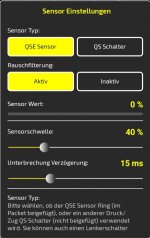
Sensor threshold 80% - to avoid random early cuts. I tried 60 to 80 depending on boots as my foot position is awkward but I might be able to improve this with lower footpegs. I mounted it under the bolt of the shift arm as it wont fit on the rod and it appears to be very sensitive in this position in both directions. 5Nm is inadequate but I didn't want to just keep tightening it forever in case it crushed the sensor so I used a little Loctite Bearing Retainer on the shaft.

QSE Sensor+ - so it doesn't work on downshifts as I was getting a cut as I prepared to shift down. No one from Healtech or the shop I bought it from can explain exactly how you are meant to do this, especially if I still need to blip the throttle anyway.
 
So, here is a topic which will interest very few of you as the new bikes have a stock QS, but as I saw some others use the Healtech shifter and wanted to share experiance:

I have tested multi positions and find that I get the best results when run mine on the shift shaft and use the hidden + function.

It works smooth 1st to 2nd and every other gear at every rpm and load, with one exception:

-Because 6th is much closer than the other gears, the 5th to 6th shift while just cruisin at low load around 7-7.5k Rpm always jumps, and if I adjust it so it is smooth, then the other gears all nose dive at that exact rpm, so I set it so that all gears work smooth except 5 to 6 at exactly 7-7.5k, and I just rev it few rpm more before I shift 5 to 6 as I do in the other gears.

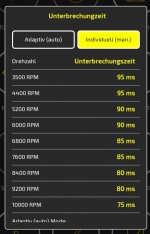
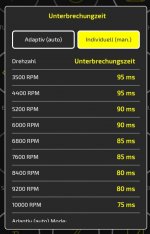
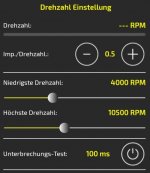
And I reduced my first rpm from 4000 to 3500 amd max from 10500 to 10000 rpm because then the rpm for the incremental change starts a bit earleier for each increment, and it seemed to help alot at a few different spots to make it smoother.

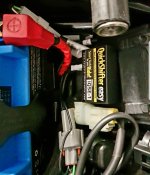
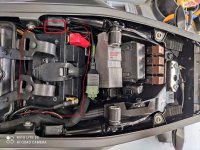
Here is the install locations of the unit and sensor as well as the setting which work best for me:

Screenshot_20210608-172740_Gallery.jpg
Screenshot_20210608-172543_Gallery.jpg

Screenshot_20210608-172640_QuickShifer easy (iQSE).jpg

Screenshot_20210608-072342_QuickShifer easy (iQSE).jpg

P.s. I contacted healtech directly per email and they were pretty helpfull and answered my questions pretty quickly to help me get a good starting point.
 
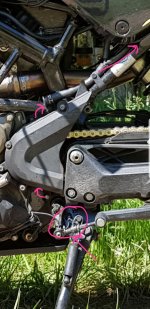
Here is a picture where the position of the Quickshifter Sensor on the linkage and the cable routing is visible: (and also my oil temp sensor 😉)

Screenshot_20210622-172402_Gallery.jpg
 
Mine is fitted slightly differently.

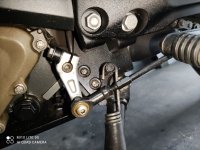
I did have it mounted on the shaft bolt rather than the rod as there aren't enough threads for it to comfortably fit. It works like this and is very out of the way but it required loctite bearing retainer on the shaft and far more torque than they recommend.
1 old location IMG_20210603_170612.jpg

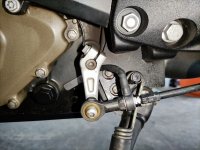
I have now moved it to the rod after I extended the threads a little by forcing the nut further on. I also put some heat shrink over it. You need to be careful because the spring will cut the cable if you point it inwards.
2 new location IMG_20210630_111837.jpg

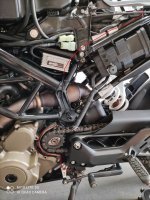
I route the cable behind the metal chain guard by removing the plastic cover, I would heat shrink the whole cable if you can find the right size. It doesn't get hot enough back there to cause it to shrink by itself. It is then on the outside to keep it away from the exhaust.
3 routing IMG_20210630_111837.jpg

As I have an OBD2 device connected I needed a different mounting point and chose the side of the battery. The wires can be routed either way and I can get to the device from under the seat if needed.
4 location IMG_20210615_202526.jpg

The wires from the injector are routed up the right side of the bike and tucked behind the grey tail section. All the panels need to come off and the tank lifted to fit that part so its a two person job unless you really know what you are doing. Don't fill the tank with fuel just before you try this like I did!

5 location IMG_20210615_193453.jpg

I am having some odd issues with mine so it will probably need be replaced but overall other people seem to say they are reliable.
 
... as there aren't enough threads for it to comfortably fit...

I removed the linkage and rotated the one side out a bit more than the side without sensor and also had to remove the arm from the shift shaft, rotate it one tooth and reattach it in order to put the lever in the right spot for me.
 
It was more to do with the sensor and washers using up all but two of the available threads on the other side and I didn't feel comfortable with it like that. When I used the nut to cut an extra couple of threads on the rod it fit perfectly.

How much of a jerk is acceptable when changing gears? I still get a noticeable one in a few gears, worst is changing 1-2 unless I am >9k and other gears are fine above 5k I think but If you got it smooth everywhere I'm going to try your manual timings.
 
I find that at 4-5k rpm I can shift super smooth 1st through 4th when cruising "low profile".

There is always one spot though that I have not been able to get smooth at somewhere around 8k rpm, so I just either shift before or after that range.

And for the 6th I need to take it a bit higher through that 8k area because its shorter ratio difference than between the other gears.

In general I always use the shifter, no matter how much throttle, during acceleration.
I think its nice especially if I need to shift mid turn, or if it starts to wheelie or powerslide just upshift and its settled.
 
How much of a jerk is acceptable when changing gears?

Absolutely 0 jerk.

One thing to note, depending on which exhaust or air filter I use, I do sometimes adjust the first and/or last RPM up or down a bit to get it just right, because it changes where the steps are at by a few hundred rpm.

(Example: instead of 3500 and 10000, sometime its better with 4000 and 10500, or 4500 and 11000.)

Screenshot_20210702-204744_QuickShifer easy (iQSE).jpg
 
Just done about 20 miles and it seems better, even 1-2 at 6k where I wouldn't shift before.

Below that I tend to still put a bit of pressure on the clutch lever as I won't be accelerating fast if I want to change so early.

I didn't like the idea of it shifting itself at low revs and I think I was mistaking what the jerk actually meant. Assuming I always needed more cutoff time when I really needed less.

For me it was not just about fun but safety, setting off and immediately changing up to second on a roundabout always makes nervous.
 
For me it was not just about fun but safety, setting off and immediately changing up to second on a roundabout always makes nervous.

Yes, that why I did it too.
And its exactly when it is amazing, like if there are unexpected leaves or sand or wet and the rear come around, I just bump the shifter.

Or in grass or mud, that low rpm shift is key.
 
Sorted it by lowering the cutoff delay to 10ms.

I am convinced that the ergonomics, size of shifter and my choice of soft boots are the problem behind my shift issues when they happen. This was another reason for buying the QS but if did t make it much better. I have to be very deliberate when shifting to make sure it goes all the way in and it feels like I take all the pressure on my big toe.

Lowering that setting made if feel a lot easier with the QS.
 
... the ergonomics...

I spent alot of time finding the lever position to where I can shift "ergonomically" with both boots and skate shoes.

Now I typically have issues under few conditions:
Shifter arm screw comes loose
Chain slack get to much
Oil is too old (once I feel it on the shifting, I know its time)
 
Have you considered replacing the end of the shift arm with something bigger? People have measured it and said the peg is smaller than other bikes.


I don't have the required tooling to make one like that but if I can remove the rubber without damage I could easily 3d printing an extension which clamps on to the metal underneath. This would tell me whether it was worth finding or making a permanent replacement. Although a GoogleSearch "shift peg extender KTM" shows there are readily available parts for other bikes to do exactly this.

Also though about those adjustable off road foot pegs that rotate around the clamp giving and extra but of room in the direction chosen but not sure which are compatible with our bike. GoogleSearch "adjustable motorcycle foot pegs"
 
Last edited:
Back
Top Bottom