
You are using an out of date browser. It may not display this or other websites correctly.
You should upgrade or use an alternative browser.
You should upgrade or use an alternative browser.
801 320mm brake discs
- Thread starter Tom
- Start date


ok, so what is a better choice
Brembo https://www.genialmotor.it/en/brake...MI2uvMi5m-lQMV9FJBAh2GTxrqEAAYASAAEgL2BPD_BwE
Or
Galfer https://www.genialmotor.it/en/galfe...e-320x5m-ktm-890-duke-r-2019-2020-282219.html
Brembo https://www.genialmotor.it/en/brake...MI2uvMi5m-lQMV9FJBAh2GTxrqEAAYASAAEgL2BPD_BwE
Or
Galfer https://www.genialmotor.it/en/galfe...e-320x5m-ktm-890-duke-r-2019-2020-282219.html

The Galfers look superb.ok, so what is a better choice
Brembo https://www.genialmotor.it/en/brake...MI2uvMi5m-lQMV9FJBAh2GTxrqEAAYASAAEgL2BPD_BwE
Or
Galfer https://www.genialmotor.it/en/galfe...e-320x5m-ktm-890-duke-r-2019-2020-282219.html
I am not skilled enough, but ... if I use for example Brembo M4.32, these calipers are same dimensions and same diameter of brake cylinders (pistons) as the original JJ. So they would brake "the same", no? Or? Where should the better braking come from??
If I will fit some M50, it will have bigger diameter of the cylinders, which means, that there will much longer lever movement on the master pump, no? But brake better, this is clear.
I was surprised, that 300=>320 discs will make just 6,7% difference of stopping power ... due to my mathematics :-D
If I will fit some M50, it will have bigger diameter of the cylinders, which means, that there will much longer lever movement on the master pump, no? But brake better, this is clear.
I was surprised, that 300=>320 discs will make just 6,7% difference of stopping power ... due to my mathematics :-D
I am not skilled enough, but ... if I use for example Brembo M4.32, these calipers are same dimensions and same diameter of brake cylinders (pistons) as the original JJ. So they would brake "the same", no? Or? Where should the better braking come from??
If I will fit some M50, it will have bigger diameter of the cylinders, which means, that there will much longer lever movement on the master pump, no? But brake better, this is clear.
I was surprised, that 300=>320 discs will make just 6,7% difference of stopping power ... due to my mathematics :-D
6.7% is the difference between breaking on time ore not, hehehe.
I am not skilled neither but I guess the Brembo M4 will be more rigid therefore loosing less power and you will probably feel it in the initial bite. I guess they will also handle better the heating when breaking hard.
For me the original JJs are good enough for street but I do not like the initial bite, it is too progressive. Perhaps changing the master cylinder will have more direct impact in braking power.
toast449
top rider
None of this is really about braking power, it is about having more thermal overhead. Unless you are tracking your bike going to other calipers or larger rotors is simply not necessary - the brakes are sufficient to lock up the tire so there is more stopping force available than traction. However there appears to be some issue with the metallurgy of the stock rotors and they way the are prone to warping, so that is a reason to switch. The fact that you can get larger rotors that save 1kg each is another. Looking cool like a racer is a third. If you just don't like the initial bite switch pads and save hundreds of dollars over calipers.
For those who might be interested, here the weights of the various Galfer and Brembo brake discs.
Galfer DF801CW; 300mm: 1175gr
Galfer DF787CW; 320mm: 1380gr
Brembo Oro 78B408B0: 320mm: 1620gr
OEM KTM-Galfer; 300mm: 1858gr.
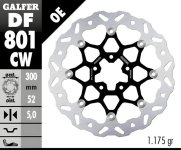
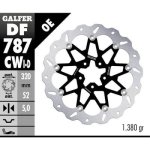
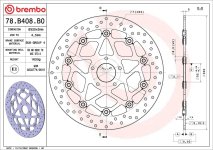
Galfer DF801CW; 300mm: 1175gr
Galfer DF787CW; 320mm: 1380gr
Brembo Oro 78B408B0: 320mm: 1620gr
OEM KTM-Galfer; 300mm: 1858gr.
Last edited:
I didn't like the braking performance right from the start either; I replaced the stock pads with ZCOO ones, and it improved significantly. I'm happy with it as it is for now.
Besides, as long as you keep the Pirelli MT60RS tires on, the braking will always be poor.
Besides, as long as you keep the Pirelli MT60RS tires on, the braking will always be poor.
I found almost new calipers from SA1290R close to my home for 200€, so I went to buy them. They fit 1:1, Rottweiler performance used them on Duke 790 also.
Change was easy. I went just for a short ride. It went better with each braking, don ´t know, if the pads are fully settled, but it brakes better. Feeling on the lever is almost same, which is not a surprise.
Change the pads will probably be enough.
Anyway I am still thinking to get 890R or new 990R, but keep the 801, because I love, how easy the bike handles and how comfortable it is.
I also visited a dyno, but nobody is able to unlock/break in to the ECU. If that will happend, with the suspension and brakes now, I will have 801R :-D
Change was easy. I went just for a short ride. It went better with each braking, don ´t know, if the pads are fully settled, but it brakes better. Feeling on the lever is almost same, which is not a surprise.
Change the pads will probably be enough.
Anyway I am still thinking to get 890R or new 990R, but keep the 801, because I love, how easy the bike handles and how comfortable it is.
I also visited a dyno, but nobody is able to unlock/break in to the ECU. If that will happend, with the suspension and brakes now, I will have 801R :-D
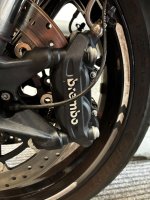
I found this a great read, describing the different stages of brake upgrades:

 www.motorcycle.com
At this point in the project, the combination of the OEM master cylinder, the EBC pads ($80), and the PowerParts discs ($458) provided more than adequate stopping power for hauling the bike down from speed. Still, I wanted more immediate application of the front brake with less free play in the lever. While I didn’t have the budget for a full Brembo system, including M50s, I decided to try a Brembo 17 RCS Costa Corta master cylinder to see if it would get me to where I wanted to be. Long story short, the 17mm piston was too small for the piston sizes of the J.Juan calipers, and I ended up using the Brembo 19 RCS Corsa Corta($372). Now, I have the braking power, feel, free play, and adjustability I wanted all along. However, those M50s – or maybe some Stylemas – still call to me late at night, when I’m cruising the net…
KTM 790 Duke Project: Building A 790 R
When I initiated this project with MO’s long-term 790 Duke, my goal was simple.I just wanted an excuse to keep the bike as long as possible before I would be required to give it back to KTM.However, even before I considered buying the 790 for myself, I hatched another plan.
www.motorcycle.com
Better Brakes
Brake upgrades were among the first changes I made to the bike, and I’m happy with the progression throughout the course of this project. The baby step of fitting EBC Double-H pads delivered the desired initial bite of the brakes, while the KTM PowerParts/Galfer Wave Discs improved the overall stopping power with the added benefit of significantly reducing the weight. For a while, I was satisfied with this arrangement. That is, until I rode the 2020 Triumph Street Triple RS, with its Brembo MCS master cylinder and M50 calipers. This started me thinking.At this point in the project, the combination of the OEM master cylinder, the EBC pads ($80), and the PowerParts discs ($458) provided more than adequate stopping power for hauling the bike down from speed. Still, I wanted more immediate application of the front brake with less free play in the lever. While I didn’t have the budget for a full Brembo system, including M50s, I decided to try a Brembo 17 RCS Costa Corta master cylinder to see if it would get me to where I wanted to be. Long story short, the 17mm piston was too small for the piston sizes of the J.Juan calipers, and I ended up using the Brembo 19 RCS Corsa Corta($372). Now, I have the braking power, feel, free play, and adjustability I wanted all along. However, those M50s – or maybe some Stylemas – still call to me late at night, when I’m cruising the net…

I had the 990R as a loan bike for a day. I really liked it! A lot better brakes and suspension than the 801 and of course some added power (130hp vs 105hp). Too bad I really dislike the colors on the 990R. Orange rims will be a pain to keep clean.I found almost new calipers from SA1290R close to my home for 200€, so I went to buy them. They fit 1:1, Rottweiler performance used them on Duke 790 also.
Change was easy. I went just for a short ride. It went better with each braking, don ´t know, if the pads are fully settled, but it brakes better. Feeling on the lever is almost same, which is not a surprise.
Change the pads will probably be enough.
Anyway I am still thinking to get 890R or new 990R, but keep the 801, because I love, how easy the bike handles and how comfortable it is.
I also visited a dyno, but nobody is able to unlock/break in to the ECU. If that will happend, with the suspension and brakes now, I will have 801R :-D
So after bedding in, the brake power is significantly better. We can not await brake power as 890R with just a small upgrade I have made, but is significant. Now with the huge suspension upgrade and better brakes the Svartie is a fantastic bike. It is so wonderful that I am in process of getting Duke 890R or 990R as a more extreme variant of Svartpilen :-D Clear is, that I will keep my Svartie anyway. Sounds stupid to have 3rd naked bike in a garage, but it is stronger then me :-D
Last edited:
So I rode my friend´s 890R with Full Akrap system+map and it is not anything like "Svart on steroids", which I honestly expected. It is different bike, nothing even a bit simillar. Total evil, honestly the bike is scary :-D It feels so short and slim, that Svart right after felt like a huge and wide scrambler. Reality is, that 890R is higher and 10cm longer!
The brakes are from different world, it is not compareable at all.
Result? He would like to sell, I would like to buy :-D But Svart I will keep.
The brakes are from different world, it is not compareable at all.
Result? He would like to sell, I would like to buy :-D But Svart I will keep.
BareseInMoto
contributing rider
Are the original bolts long enough with spacers added?
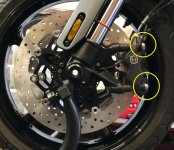
No, they are too short. The original bolts are M10x1.25x55, you need M10x1.25x65; you can buy them from KTM.Are the original bolts long enough with spacers added?
They are called: "AH collar screw M10x1.25x65SS"; part-number: 0035100659
BareseInMoto
contributing rider
Perfect, thanks Tom!No, they are too short. The original bolts are M10x1.25x55, you need M10x1.25x65; you can buy them from KTM.
They are called: "AH collar screw M10x1.25x65SS"; part-number: 0035100659
From what I've read it's mainly the material of the stock/OEM Galfer discs that causes the problem; the quality of the after market Galfer discs seems to be better.
But it's not just the warping; a webfind; some pics of some stock/OEM 890-R Galfer discs; I've never seen something similar at any bike...
source
View attachment 8712 View attachment 8713 View attachment 8714 View attachment 8715 View attachment 8716 View attachment 8717
On my 701 Vitpilen (cast wheel model, they are different), I had very similar on the standard rotor. Galfer made.