

Vintage Veloce
pro rider
I replaced my Turn Signals with with these slim sequential ones:
and I used this relay to fix the "fast flash" / "hyper flash issue:
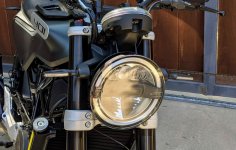
I like the turn signals, they work great and were very inexpensive. But they may not be molded perfectly and don't all stick "perfectly" straight out. That is about the same as the stock original ones! That may be impossible to avoid because the mounting points on the husky are plastic and may not be perfectly perpendicular to the bike.
I actually found some great directions over at the vitipilenforum by pioneer401. I'm going to include them below in case anyone else finds them helpful. Thanks pioneer401!
He used different turn signals but the process mostly the same. The biggest difference is my signals did not come with a matching connector, so I cut the connectors off of the stock signals and soldered them to the new ones. Be sure to test the polarity before you solder them up.
I did this on a 2020, and it was the same as these directions as performed on an earlier bike 2018 or 2019 Vitpilen 401
pioneer401's post:
Amazon.com: Led Motorcycle Turn Signals Indicator Amber Light Compatible with all Motorcycles Harley Prince Large-Displacement Motorbikes Off-Road Vehicles Suzuki Haojue Honda Yamaha Modified: Automotive
Buy Led Motorcycle Turn Signals Indicator Amber Light Compatible with all Motorcycles Harley Prince Large-Displacement Motorbikes Off-Road Vehicles Suzuki Haojue Honda Yamaha Modified: Automotive - Amazon.com ✓ FREE DELIVERY possible on eligible purchases
www.amazon.com
and I used this relay to fix the "fast flash" / "hyper flash issue:
I like the turn signals, they work great and were very inexpensive. But they may not be molded perfectly and don't all stick "perfectly" straight out. That is about the same as the stock original ones! That may be impossible to avoid because the mounting points on the husky are plastic and may not be perfectly perpendicular to the bike.
I actually found some great directions over at the vitipilenforum by pioneer401. I'm going to include them below in case anyone else finds them helpful. Thanks pioneer401!
He used different turn signals but the process mostly the same. The biggest difference is my signals did not come with a matching connector, so I cut the connectors off of the stock signals and soldered them to the new ones. Be sure to test the polarity before you solder them up.
I did this on a 2020, and it was the same as these directions as performed on an earlier bike 2018 or 2019 Vitpilen 401
pioneer401's post:
There’s a lot of partial info out there about turn signals, hyper flash issues, etc. so I documented my DIY install procedure as a reference that might be helpful to others. I am not getting any compensation for this write-up, I chose these specific products because I liked them and paid normal price. This should work for the Svartpilen as well, anyone who tries it, please reply! Good luck
2018 Vitpilen 401 (US Spec) – New Rage Cycles front turn signal install, CustomLED ELFR-1 relay
Parts:
Tools:
- New Rage Cycles Husqvarna Vitpilen 701 Front Turn Signals, Part# 701-FB http://www.newragecycles.com/Husqvarna_Vitpilen_701_Motorcycle_Accessories_s/2052.htm
- Note: they are for the Vitpilen 701 and are not stated as 401 compatible, but they work
- CustomLED ELFR-1 Flasher Relay with OEM Connector
https://www.customled.com/products/elfr-1-electronic-led-flasher-relay
Turn Signal Install Procedure:
- M5, M13 open ended wrenches
- T20, T25 Torx hex bits/drivers
- Small Phillips screwdriver
1. Remove (2) T20 torx screws above the headlight and (2) T20 torx screws below and to the rear of the headlight, accessible behind the forks.


2. Pull forward the headlight/instrument assembly. It will tilt forward and out of the way. Consider wrapping the assembly in a towel to prevent scratches to the lens or instruments.
3. Remove (9) T25 torx screws holding the front half of the electrical system box cover


4. With electrical system box cover lifted away, (2) M13 nuts are exposed to remove the stock turn signals. The two electrical connections are tucked back and routed through the housing, unplug and remove.


5. Take NRC turn signal, and remove (2) flat head screws above lens to separate from bracket. Take provided M6x16 screw and M5 hex nut and mount the bracket to the rear position, not the same as where the M13 hex nuts were. Repeat on both sides.


6. Reassemble lens to top bracket with (2) flat head screws removed in last step. Feed wire through the bracket opening and route through existing cable channels in electrical system housing. Plug connectors together and test turn signal operation before reassembly.

7. Reassemble the electrical system box cover with (9) T20 torx screws and remount headlight/instrument assembly with (4) T25 torx screws.
If in step 6, you find the turn signals flash faster than normal, aka hyper flash, then modification to the electrical system is necessary. Resistors can be used on the turn signals to solve this. I opted to replace the stock flasher unit with a CustomLED ELFR-1. There are a couple reasons I chose this over resistors:
Relay install procedure:
- No cutting the stock wiring harness
- One item to install which corrects all turn signals instead of 2 or 4 resistors to be installed
- Resistors generate heat and it is recommended to mount them to metal surfaces to help dissipate the heat. Inside the front electrical system housing there are no metal surfaces to mount to and heat would be trapped inside the housing
1. Just behind the forks at the point where the top of the subframe meets the steering head tube there is a v-shaped plastic cover. Remove (2) T25 screws to expose wiring harness.


2. The flasher relay (part 30) is housed in a rubber strap/boot (part 31) which slides onto a flat metal support. There are three components like this in a triangle arrangement within the opening in the frame. The flasher relay is the one to the riders left, rear position. Slide the rubber boot off the support and extend to expose the stock relay and cable (parts 29-31).


3. The stock flasher relay has 2-pins and connects via the extension cable (part 29). The cable connects to the bike wiring harness with a three-pin connector. The CustomLED ELFR-1 has a three-pin connector so it can connect directly to the bikes wiring harness without the extension cable.
4. The CustomLED ELFR-1 pins are not in the correct positons for the Vitpilen 401 wiring harness so it is necessary to move the pins positions on the ELFR-1 to match the wiring harness.
Source: https://cdn.shopify.com/s/files/1/0190/4226/files/ELFR-1_Installation.pdf?100
- Red wire on ELFR-1 to power source, +12v
- Black wire to blinker circuit supply wire, pulses intermittent +12v with flasher relay installed


5. Connect, turn on ignition and test the turn signals for proper flash rate
6. The CustomLED ELFR-1 can fit into the stock rubber strap/boot and mounted back to the stock mounting position on the frame. Replace v-shaped plastic cover with (2) stock T25 screws.

