TANK SLAPPER!!!

BISavage

champion rider
Joined
Oct 8, 2020
Messages
2,497
Location
Unspoken Origins
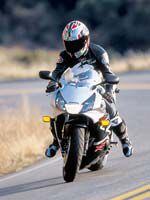
Exactly as the title suggests, tank slapper.

After getting the rear end dialed following my fork spring upgrade and fork oil change I went out to test the high speed handling; on the Autobahn. While doing 180 km/h a car went to pass and the wind was enough to provoke a full on tank slapper... at 180 (thats over 100mph) And it lasted forever...I mean I had enough time to think of what I want to do next to try to stop it from slapping.

Long story short, I called Hyperpro and the recommendation came to slide up the forks in the clamps a bit.

Did it, tested it, works.
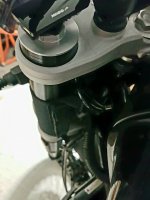
20210326_205149.jpg
 
I find this an odd suggestion from Hyperpro perhaps someone else can explain,

To my understanding sliding the forks up the clamp will reduce your wheelbase (trail) which is better for cornering but worse for straight line stability.

what you want is better straight line stability so you should be sliding the forks further down the clamp.
 
Went through all the parameters and that was the suggestion. I did note how the bike felt like the rear end was planted much more solid than previously (before lengthening the chain to a 114 and upgrading the fork springs/oil).

And an added benefit, on a full tank the fuel guage reads completely full now for the first time.
 
FWIW I read this interesting description of how tank slappers happen. Don't know if it's always true, but sounds reasonable:
The “tankslapper” is a very frightening experience. Usually occuring when accelerating hard over bumpy pavement, a tankslapper ensues when the front tyre becomes airborne, then regains traction outside the rear tyre’s alignment. The resulting deflection bounces the tyre off to one side, followed by another bounce in the opposite direction as it contacts the pavement again. Unless the bike’s steering geometry is able to damp out the deflections quickly, the resulting oscillations from the front tyre as it bounces back and forth will swiftly gain in strength, causing the bars to swap from side to side with increasing ferocity. The oscillations can be violent enough to rip the bars out of your hands, and fling your feet off the pegs. You can guess what happens next.
 
Found this on quora, which seems to go along with what Sisco pointed out,

"Suspension setup — when you go over a bump in the road, or when your machine experiences a force from wind, or your right hand twisting the throttle, the suspension responds. It needs to respond proportionally to the load that is on your bike. If the sag is not set correctly, front end may be loaded too much, or too little, resulting in the trailing effect of your front wheel being magnified, BAM, tank slapper — This is probably the most common cause of vibration and tank slappers"

 
Yikes! And I'm puzzled by that advice too to raise the forks in the clamp too.
Glad you resolved it safely!
I am thinking that this is to transfer more weight on the the front end so that you are more in the middle of the stroke instead of topping out.
what sag are you at with your new front springs?
 
try putting your forks flush with the top triple clamp, and feel the difference.
mine are flush,more straight line stability and still steers well.
 
yes i am.
Yeah, I guess the stock springs are softer than the hyperpro springs... also felt that way during the install when I muscled them down to put the caps back on.

Their both progressive so I am not sure how the springrate curve looks to be honest.

Thats pretty much the reason why I replaced the stock springs.
 
Scott's might be something to look into. Tank-slappers are NOT a fun thing.
Lastly, have all your bearings been ruled out as "probable cause?"

Especially wheel and swingarm bearings.
 
I am thinking that this is to transfer more weight on the the front end so that you are more in the middle of the stroke instead of topping out.
what sag are you at with your new front springs?

Just enlisted some help to measure...keeping in mind that since it slapp'd, slid the forks about 5 mm more through the clamp and added 2 turns of preload in the back.

Fuel 3/4 Tanked
Bike Weight: 138kg (70 front / 68 rear)
Riding Weight: 90kg (full leather, back-protector, helmet + backpack with drink, etc.)

Front Sag: 50.0 mm
Rear Sag: 48.5 mm
 
That was after the change. Normally the should go to about the second fat line, and as the pic shows they are about 4mm past it.
 
From what I understand, the correct sag for street riding should be around 38-42 mm. And for both telescoping forks as well as a linkage rear suspension make use of single rate springs.

Only linkage-free rear suspensions use should use progressive springs & dumbed-down front forks whereby one spring has to be used as a compromise for a wide variety of rider weights.
 
Back
Top Bottom